Public Watchdogs or Private Voyeurs? The Litigation in Sussex v Associated Newspapers
By Jared · Mar 06, 2026
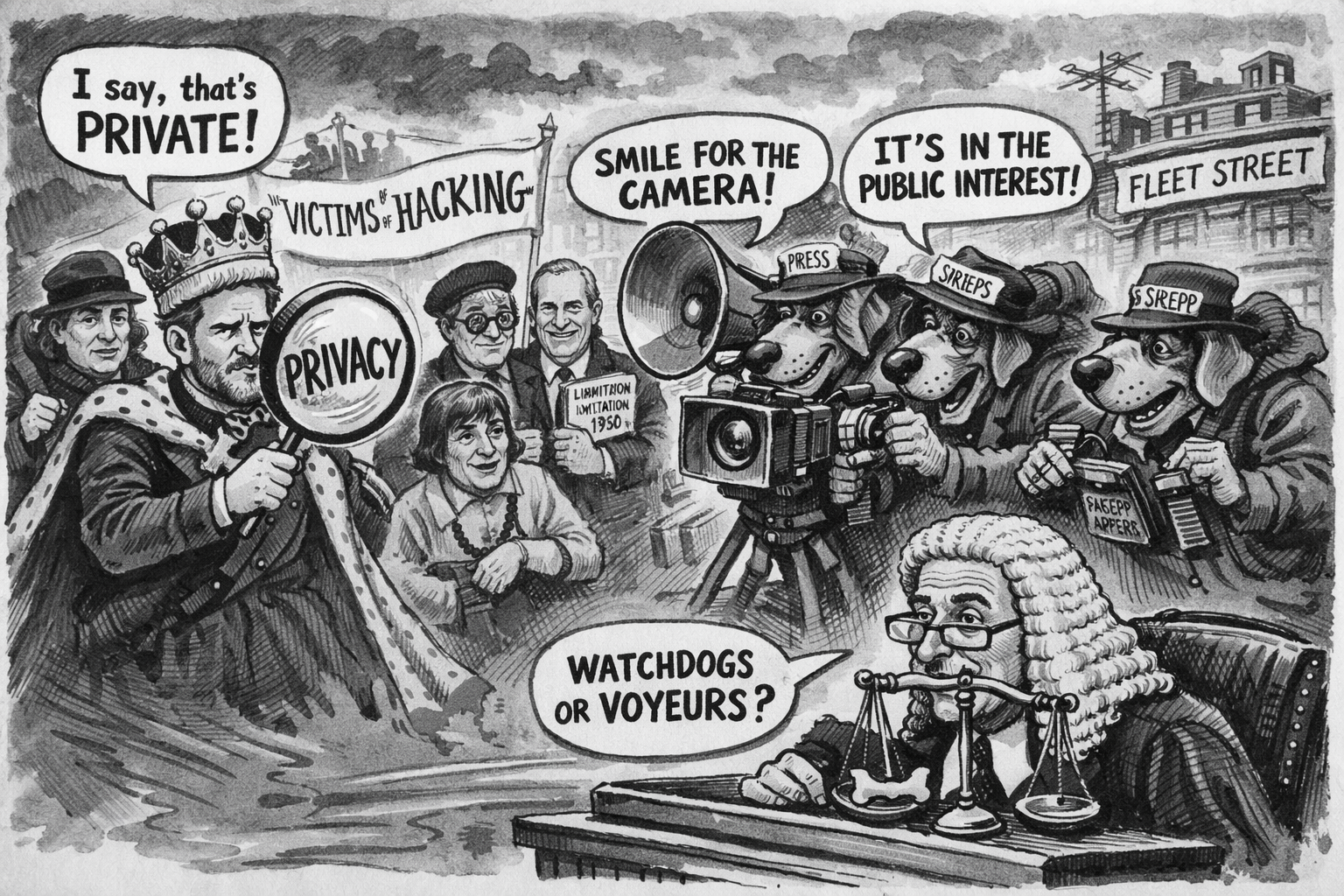
Phone Hacking, Limitation, and Press Freedom: Sussex & Others v Associated Newspapers Ltd
The High Court proceedings in Sussex & Others v Associated Newspapers Ltd raise a significant question in privacy litigation concerning historic media wrongdoing: when can claims based on alleged unlawful information gathering proceed despite the expiry of the ordinary limitation period?
Seven claimants - including Prince Harry, the Duke of Sussex; Sir Elton John and David Furnish; Elizabeth Hurley; Baroness Doreen Lawrence; Sir Simon Hughes; and Sadie Frost - bring claims against Associated Newspapers Limited (“ANL”), the publisher of the Daily Mail and Mail on Sunday. They allege that journalists acting for ANL obtained private information through unlawful means over a period spanning roughly two decades between 1993 and 2011.
The litigation forms part of the wider legacy of the phone-hacking scandals that reshaped media law in the United Kingdom during the 2010s. However, unlike earlier claims against other publishers, the central issue is not merely whether unlawful information gathering occurred, but whether the claimants are entitled to pursue claims arising from publications that occurred many years ago.
The case therefore engages two related questions: whether the alleged conduct amounts to misuse of private information through unlawful information gathering, and whether the claimants’ claims are barred by limitation.
Background
The claimants allege that ANL journalists commissioned private investigators who employed unlawful methods to obtain confidential information about them. The alleged practices include phone hacking, interception of voicemail messages, the bugging of vehicles or premises, and the acquisition of confidential records through deception or impersonation (“blagging”).
The claimants rely on a number of specific articles said to contain information that could not realistically have been obtained through lawful journalistic methods. Prince Harry relies on fourteen articles; Elizabeth Hurley on fifteen; Sadie Frost on eleven; Sir Elton John and David Furnish on ten; and Baroness Lawrence on five. Sir Simon Hughes relies instead on an alleged incident involving unlawful information gathering by a journalist.
ANL denies all allegations of wrongdoing. It contends that the information contained in the relevant publications was obtained through lawful sources, including press officers, publicists, and individuals within the claimants’ own social circles.
Limitation and Deliberate Concealment
A central issue in the litigation is limitation.
Claims for misuse of private information are generally subject to a six-year limitation period. That said, many of the articles relied upon in the proceedings were published more than fifteen or twenty years ago.
The claimants therefore rely on section 32 of the Limitation Act 1980, which postpones the commencement of the limitation period where relevant facts have been deliberately concealed. The claimants argue that the alleged unlawful information gathering practices were concealed and could not reasonably have been discovered until around October 2016.
ANL disputes this position. It argues that the publications were widely known and that the claimants could have pursued claims long before the limitation period expired.
The High Court previously refused ANL’s attempt to dispose of the claims at an early stage on limitation grounds, holding that the arguments advanced did not provide a sufficient basis to prevent the case from proceeding to trial.
The Scope of the Litigation
A further issue addressed by the High Court concerns the proper scope of the proceedings.
In a case management judgment delivered by Mr Justice Nicklin in October 2025, the Court emphasised that the litigation must focus on specific incidents of unlawful information gathering linked to the articles relied upon by the claimants.
The claimants had advanced a broader “generic case” alleging widespread unlawful information gathering practices within the defendant organisation. The Court held that attempts to prove general wrongdoing across the organisation were unlikely to assist in determining whether unlawful information gathering occurred in relation to the particular articles in dispute.
“If time and resources were unlimited, it might be possible to investigate each instance further to determine whether (unlawful information gathering) took place. However, this would entail a vast and potentially unmanageable inquiry.”
Evidence of misconduct may be admissible where it demonstrates a propensity on the part of a particular journalist or investigator to engage in unlawful information gathering. However, such evidence must be logically probative of the specific claims before the Court and connected to the individuals responsible for the publications in issue.
The Court therefore rejected attempts to expand the proceedings into a broader inquiry into the historical practices of the newspaper group, emphasising that civil litigation must remain proportionate and focused on resolving the issues necessary to determine the claimants’ individual causes of action.

Prince Harry, second right, in court at the Royal Courts Of Justice, Monday, March 27, 2023. (Elizabeth Cook/PA via AP)
Privacy, Press Freedom, and Responsibility
The proceedings revive a familiar but persistent debate within media law: the proper balance between the freedom of the press and the protection of individual privacy.
Few would dispute that a robust and independent press performs an essential constitutional function. The courts have long recognised the media’s role as a “public watchdog”, exposing wrongdoing, scrutinising those in positions of power, and contributing to matters of genuine public interest. The extensive reporting surrounding the allegations involving Andrew Mountbatten-Windsor illustrates how investigative journalism can bring matters of significant public concern into the open and subject them to public scrutiny.
It is for this reason that Article 10 of the European Convention on Human Rights affords strong protection to journalistic expression, and why courts are often reluctant to impose restrictions that might chill legitimate investigative reporting.
At the same time, the events that gave rise to the phone-hacking scandals of the past decade demonstrated that this freedom can be abused. The press’s watchdog function carries with it a corresponding responsibility to exercise that freedom within lawful and ethical limits. Where reporting serves little purpose beyond satisfying public curiosity about the private lives of individuals, the justification for intrusive methods becomes far more difficult to sustain.
The European Court of Human Rights articulated this distinction clearly in Mosley v United Kingdom. The Court drew a line between reporting “capable of contributing to a debate of general public interest” and material consisting of “tawdry allegations about an individual’s private life”. The former reflects the press’s role as a public watchdog, for which the Court favours a narrow construction of restrictions on freedom of expression. The latter, however, was characterised as journalism intended merely “to titillate and entertain”, which does not attract the same level of protection under Article 10.
In that sense, the present proceedings highlight an enduring tension in media law. Public figures undoubtedly occupy a different position from private individuals and must expect a greater degree of scrutiny. Yet it does not follow that they surrender all claims to privacy. The law continues to recognise that even those in the public eye retain a legitimate interest in the protection of their private lives, particularly where the information disclosed serves no meaningful public interest.
Seen in this light, the litigation is not merely another episode in the aftermath of the phone-hacking scandal. It is also part of a continuing effort by the courts to define the boundary between legitimate investigative journalism and unjustified intrusion into private life, ensuring that the press remains both free and accountable.
Significance
The proceedings illustrate the continuing legal consequences of the phone-hacking era for English media law.
First, they demonstrate the continuing importance of limitation and deliberate concealment arguments in historic privacy claims. The extent to which claimants can rely on section 32 of the Limitation Act 1980 will likely determine whether many such claims can proceed at all.
Secondly, the case highlights the courts’ increasing willingness to exercise robust case management powers in complex group litigation. By confining the scope of the proceedings to specific incidents of alleged unlawful information gathering, the Court has sought to prevent the litigation from becoming a wide-ranging inquiry into historical media practices.
The eventual outcome will therefore be closely watched both for its implications for historic privacy claims and for the guidance it provides on managing complex media litigation in the post phone-hacking era.
Jared Higgins
Founder, PupillagePulse